Is LiDAR faster than tape measuring?
Usually yes. A single scan visit often replaces the longer field-measuring process and reduces return trips for missed dimensions.

Tape measures still show up on renovation jobs, but they are a weak documentation method when real decisions depend on the existing building. LiDAR gives contractors and architects a more complete record to work from.
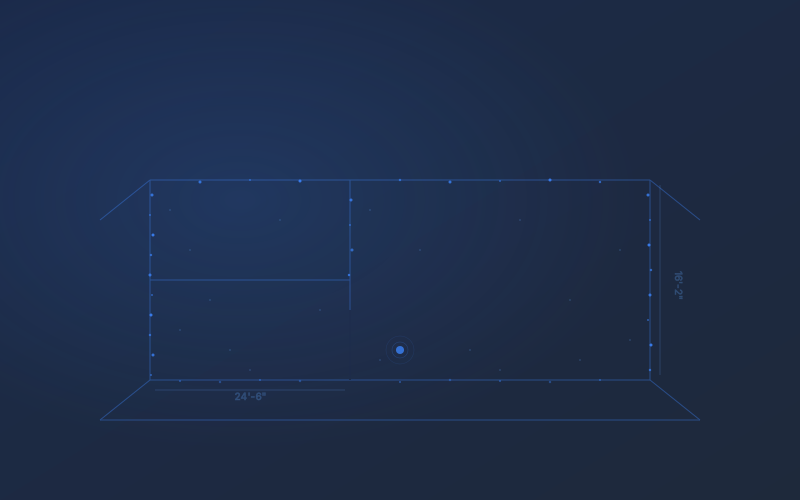
Hand measurement works best when a space is small, simple, and forgiving. Most renovation work is not. Existing buildings have offsets, out-of-square corners, soffits, layered finishes, partial obstructions, and ceiling conditions that are hard to document cleanly with a tape and a notepad. Even when a crew is careful, the process depends on human judgment at every step: where to pull from, which face to reference, whether an opening should be measured to rough or finish, and which conditions are important enough to sketch.
That creates predictable problems. Dimensions get transposed. Rooms are simplified because the geometry is awkward. Ceiling heights are skipped because ladders are not practical or because the field team is moving too fast. A corner that is not square gets drafted as if it were square. The final drawing may look complete, but the building still has hidden risk baked into it.
The other issue is that tape measures don't leave a reusable record. Once the crew leaves, the notes are all you have. If something was missed, the project either absorbs the uncertainty or pays for another trip back to the site.
LiDAR scanning captures the building as a three-dimensional dataset rather than as a collection of isolated field notes. That means the documentation process starts with complete geometry, not just selected dimensions. A scan can capture wall planes, opening locations, ceiling conditions, stair geometry, bulkheads, and irregular conditions that are easy to under-document by hand.
For renovation and as-built work, that broader record is the real advantage. A point cloud gives the drafting process something to reference long after the site visit is over. If a designer later needs to verify a wall offset or check how a corridor actually turns, the information is available in the scan data. You are not relying on whether someone wrote down the right number in the field.
We use a Matterport Pro3 for building capture because it is designed to document real spaces efficiently and create a dependable source dataset for downstream drafting. The point is not hype about equipment. The point is getting a complete record of the building so the team can work from something stronger than sketches and assumptions.
On renovation projects, building measurement accuracy is not just a technical issue. It affects layout, estimating, and field coordination. Hand measuring can be reasonably accurate in isolated spots, but it is harder to keep that consistency across an entire building, especially when different people measure different areas or when the site has poor access. LiDAR provides high accuracy across the captured space and gives the drafting team a better base file for producing dependable as-builts.
Time is the other major difference. A LiDAR site visit for many buildings can be completed in roughly one to two hours. Traditional hand measuring can stretch into multiple site visits or several field days once you account for sketching, ladder work, rechecks, and return trips for missed dimensions. That schedule drag is expensive even before drafting begins.
The cost argument is not that scanning is always the lowest line item. It is that one coordinated scan is often cheaper than repeated site visits, revised drawings, and construction questions caused by incomplete field measurement. Renovation teams usually feel the real cost later, when an error gets discovered after design work or procurement has already started.
Most field-measure mistakes don't show up as dramatic failures. They show up as wasted time. A cabinet layout no longer fits because a wall jog was missed. A demolition scope changes because the ceiling is lower than expected. A storefront opening is off enough to force a redesign. A stair clearance issue appears after the drawing is already in circulation. These are the kinds of problems that slow down otherwise routine jobs.
Commercial tenant improvements are especially vulnerable because tight schedules leave little room for rework. Residential remodels have the same problem in a smaller footprint. If the existing condition set is weak, every trade starts making its own assumptions. That fragments the job before the work even begins.
Laser scanning vs hand measuring is ultimately a decision about project risk. If the building documentation is going to guide design, estimating, and construction decisions, the stronger approach is to capture the site once and create deliverables from that dataset instead of hoping the field notes were complete enough.
Usually yes. A single scan visit often replaces the longer field-measuring process and reduces return trips for missed dimensions.
No. The scan provides the source dataset. Plans, CAD files, and models still need to be drafted into usable deliverables.
It can work on very small, simple spaces. Once geometry, ceiling conditions, or renovation risk increase, scanning is usually the better documentation method.